Cover image courtesy of EDGE.
THE GLACIAL DRIFT FEATURE
A MISTING FEATURE THAT TELLS THE STORY OF OHIO'S GLACIAL PAST
The Ohio Expo Center & State Fair sits on a large campus site in downtown Columbus, situated near The Ohio State University to the west and Interstate 71 to the east. It has spent the last several years working through one of the most substantial renovations in the fairgrounds’ history, reimagining over 50 acres through new buildings, major facility renovations, new green space, walkways, and gathering spaces. The project team, including Populous, landscape architect EDGE, and architect Wellogy, worked on behalf of the Ohio Facilities Construction Commission. The mandate came from the top; the state’s governor is, by every account, deeply invested in the fair, and that backing is a large part of why a renovation this ambitious got built at all. Crystal Fountains came into the project as a design consultant to Wellogy, brought in through a long working relationship with EDGE’s principal, Timothy Skinner. The firm was tasked with a single feature inside a much larger plan, the misting installation adjacent to the site’s new “Town Square,” a central gathering space where the renovation’s main pedestrian routes converge.
FROM A SPLASH PAD TO A STORY ABOUT ICE
The brief for that space started out considerably bigger than what exists today. Early concepts called for a full interactive water feature, with water planes, pop jets, and moving water meant to evoke the rush of Ohio’s glacial era tributaries. The idea was tied to a broader concept the team had settled on, telling the story of how the last glacial period shaped the state’s landscape. That concept went through three or four rounds of revision. Each one scaled back for practical reasons, the feature’s own operating budget and upkeep chief among them.
The fairgrounds aren’t only open two weeks a year for the State Fair itself. They host events almost every weekend, including the Quarter Horse Congress, the largest single-breed horse show in North America. That event alone takes over the site for a full month each fall. A water feature that needed to recirculate water, in a venue with that much animal traffic moving through it, raised maintenance and sanitation concerns. Those were concerns a seasonal fair feature didn’t need to carry. The operating budget was also fixed and closely managed. A full-scale interactive feature was likely to see meaningful use only a few weeks a year. So the original water feature was set aside for something with a far smaller footprint to operate and maintain. The misting installation runs on fresh potable water rather than a recirculating system. That open loop design cuts the operational and maintenance hours needed to keep it running, and keeps costs down.
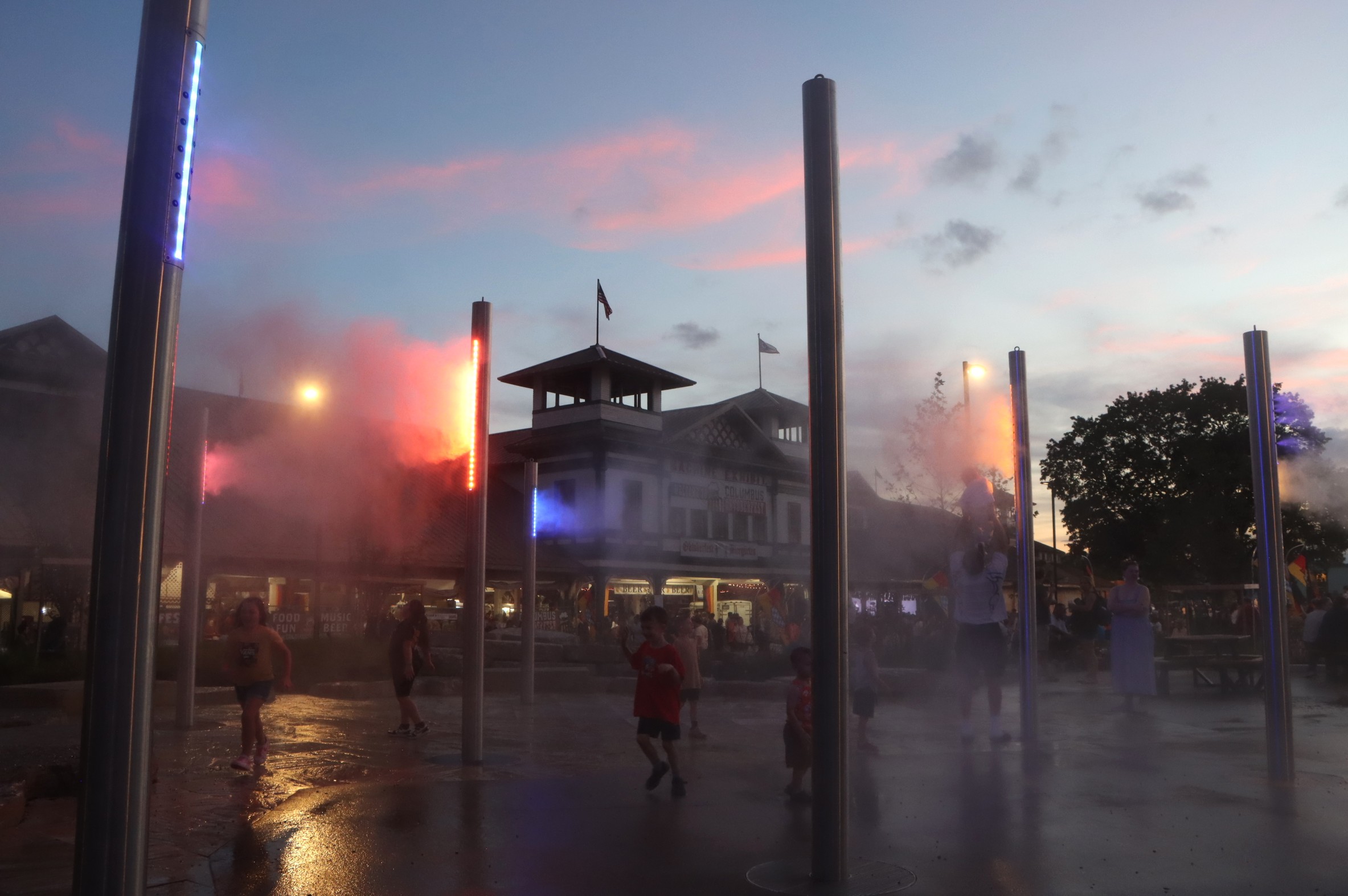
Even though the final water components were reduced in scale, they still provide an impactful effect within a space that honors the original design intent. A natural stone edge, heavily planted drift and interpretive signage tell the story of Ohio’s glacial history through physical placemaking and narrative. The misting poles add an atmospheric effect, both with a tangible connection to southern Ohio landscapes as well as their cooling relief for visitors. Finally, the eight misting poles combined with the adjacent nine shade canopy poles subtly pay homage to Ohio’s standing as the 17th state.

GEOLOGY, PLACED DELIBERATELY
While the feature evolved considerably through the design process, its connection to Ohio’s glacial history remained central. The Glacial Drift Feature is positioned adjacent to the Town Square to correspond, at an enlarged scale, with the state’s actual glacial boundary. It reinforces the transition between northern Ohio’s glaciated landscape and the unglaciated Appalachian terrain to the south. The feature sits just outside the Ohio Department of Natural Resources’ area of the fairgrounds, near the entrance most fairgoers use to reach it. Its placement was meant to extend a story ODNR was already telling next door, through its own signage about the state’s geology, history, and geography.

THE PILLARS, THE MIST & THE LIGHT
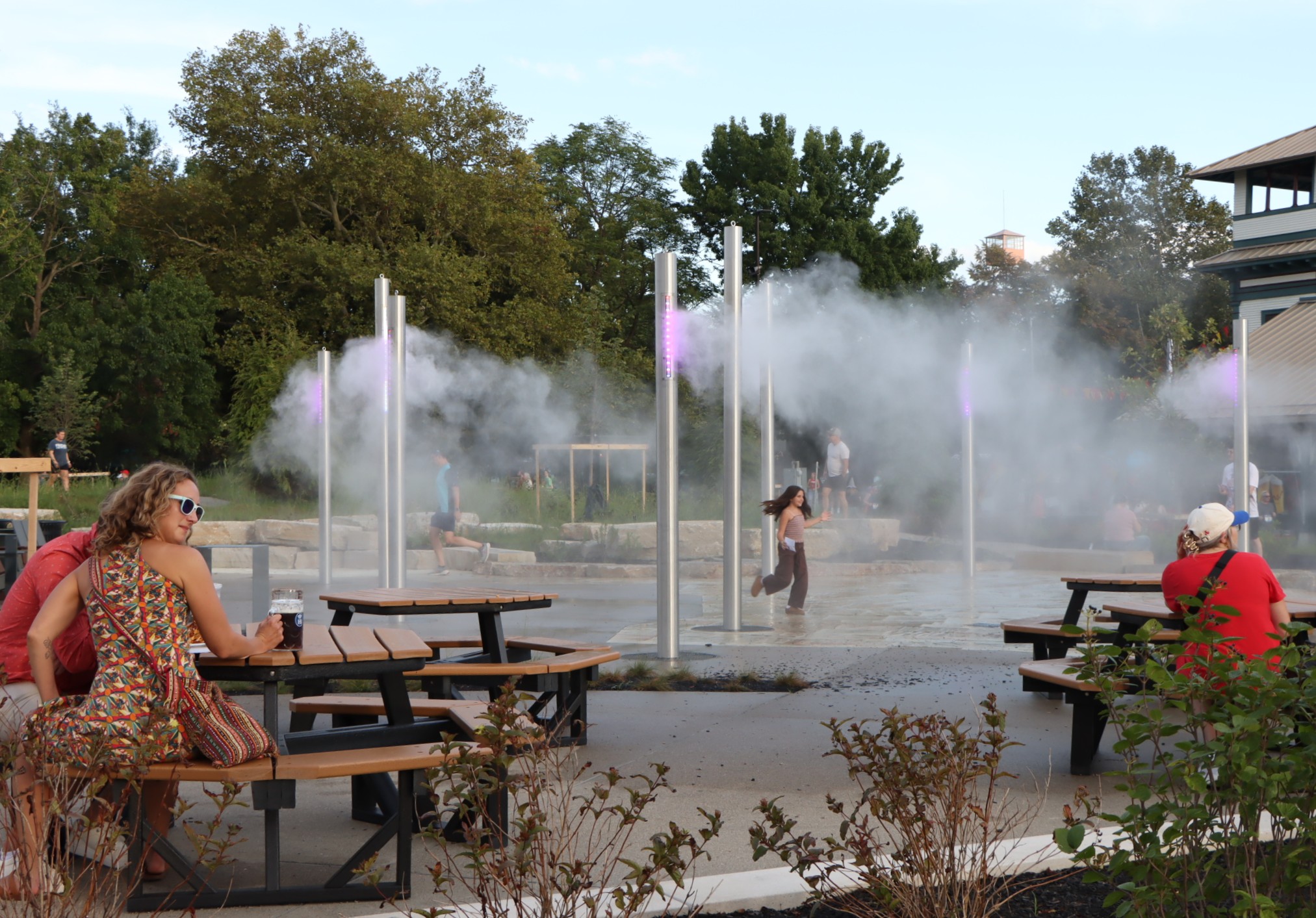
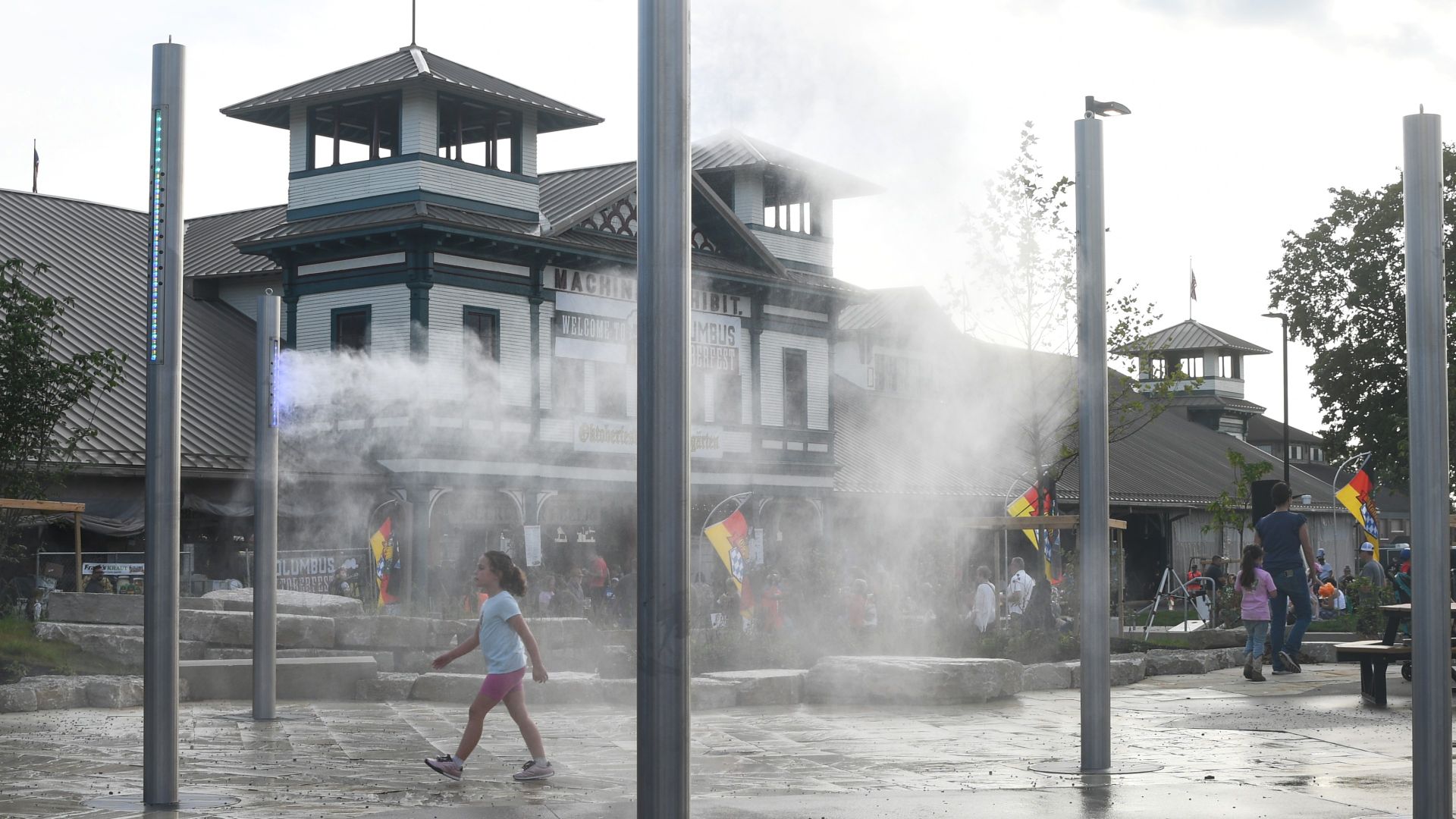
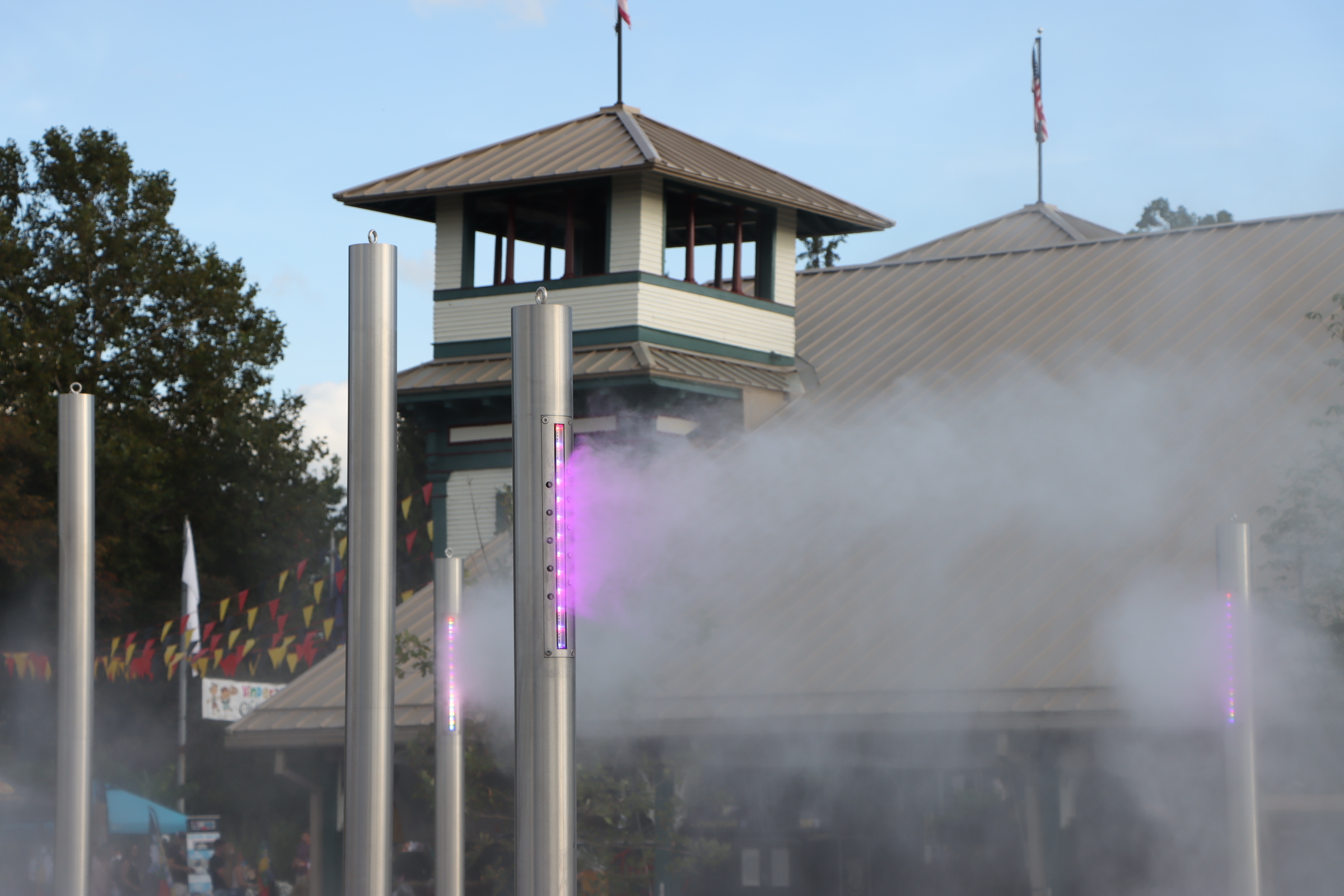
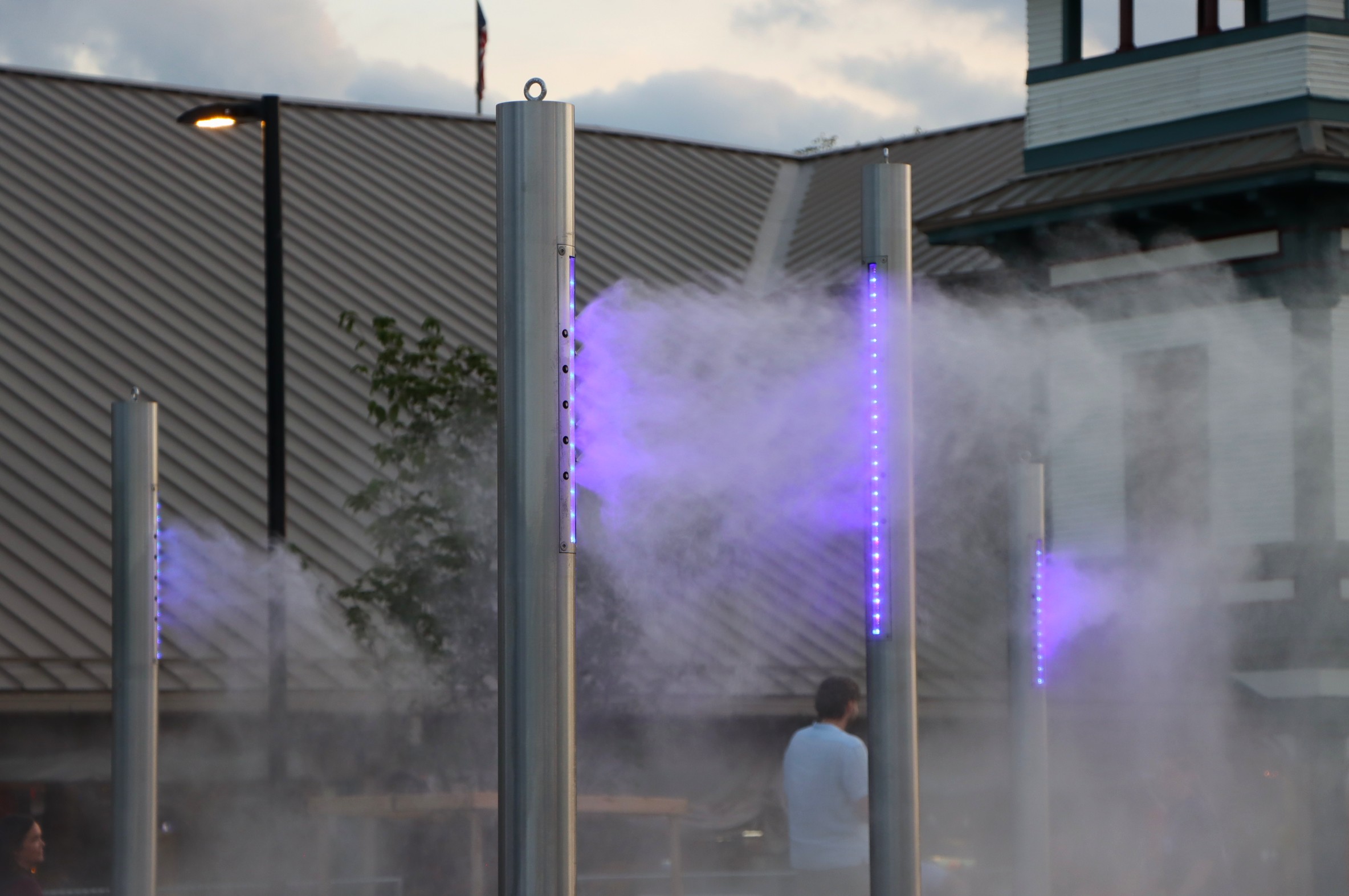
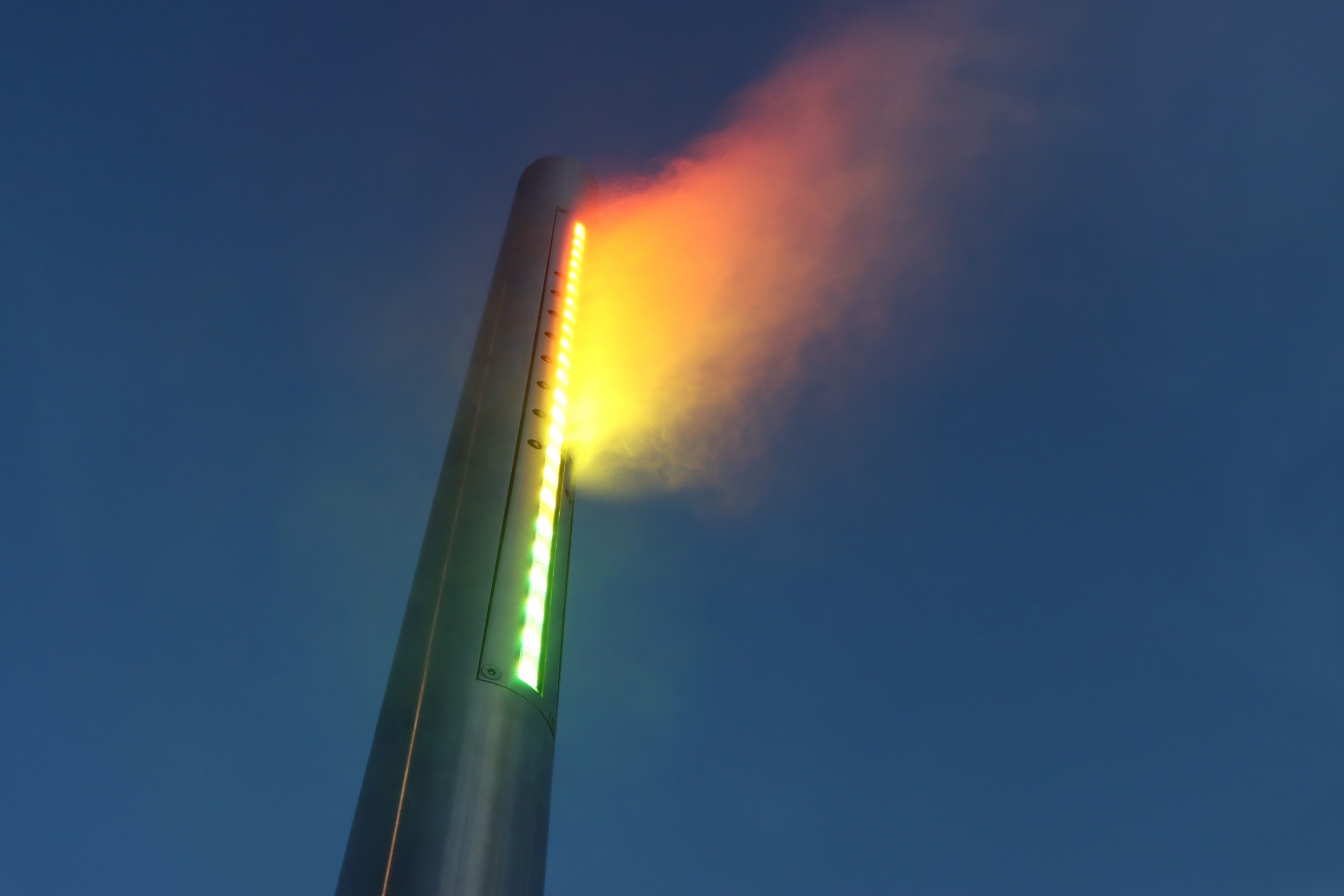
The most visible departure from a typical Crystal Fountains misting installation is that this one doesn’t sit at ground level. Custom stainless steel pillars, fabricated in-house at 10 and 12 feet, carry the fog nozzles and lighting vertically instead of flush with the paving. That decision was driven as much by safety as by design. With no walls or barriers bounding the space, any opening in the pole large enough for a nozzle or a light fixture could become a handhold. So the components were pushed as high as the structure would allow. The two heights track the adjacent shade canopy poles, giving the misting poles an informal, varied datum rather than a uniform row.
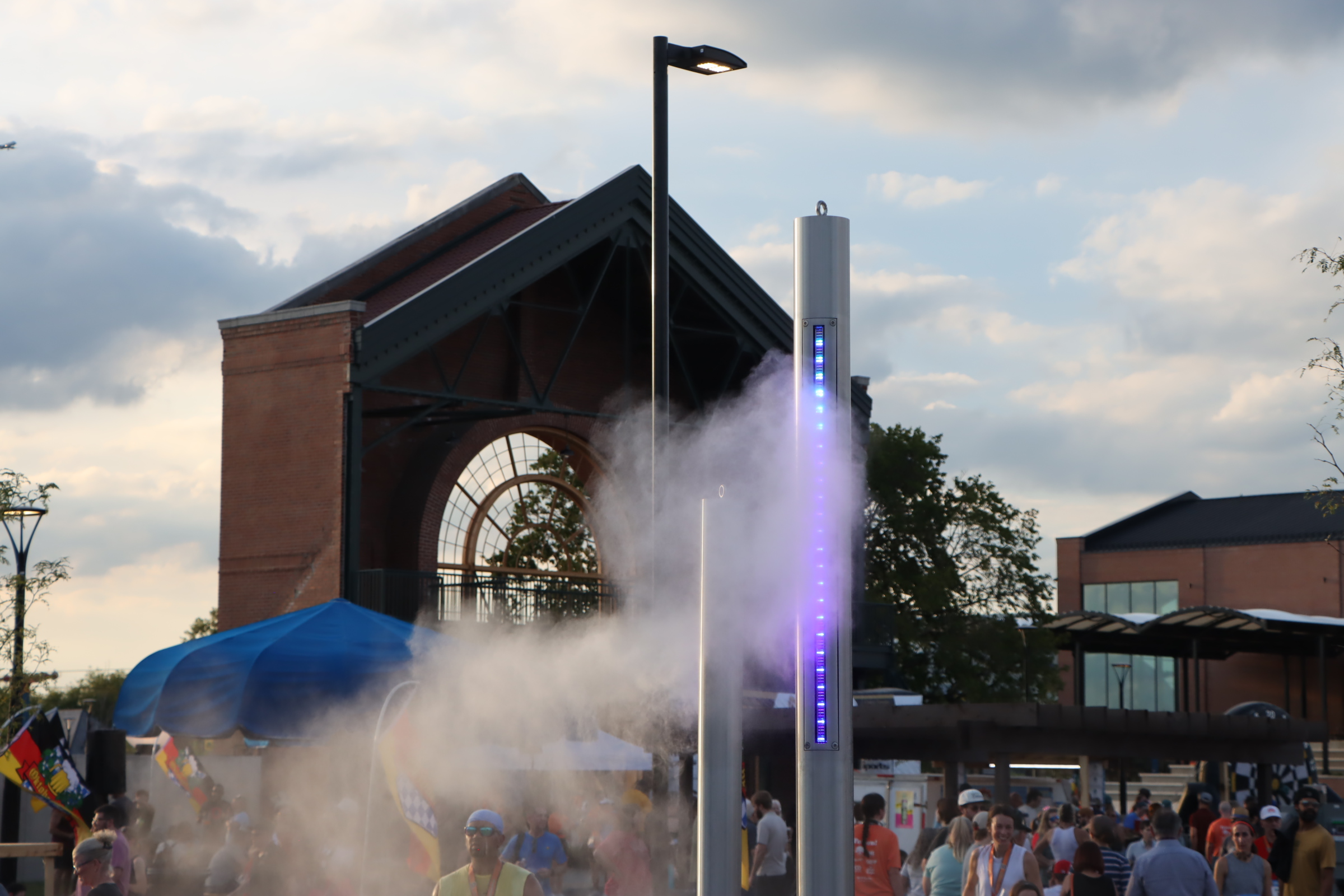
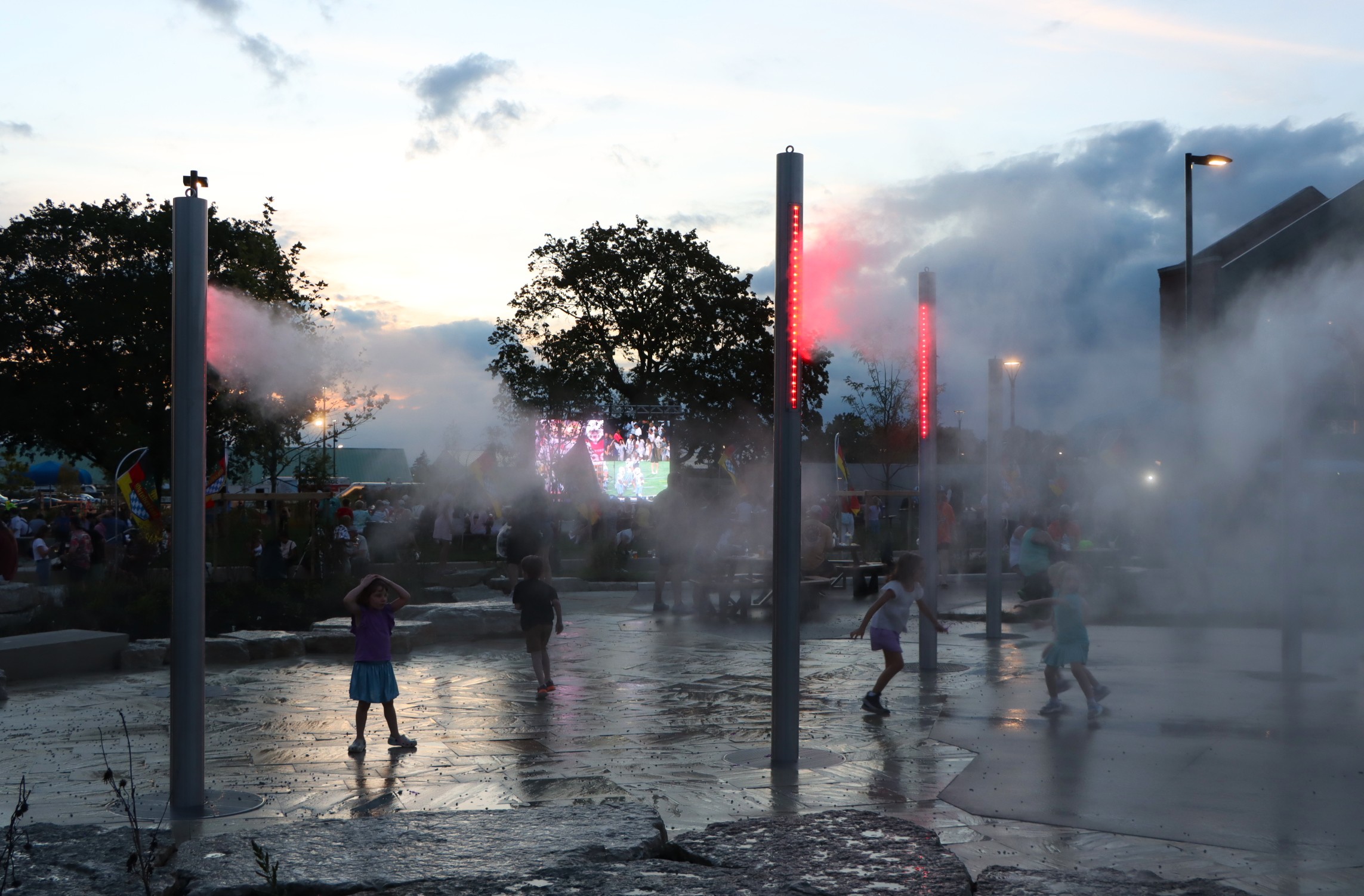
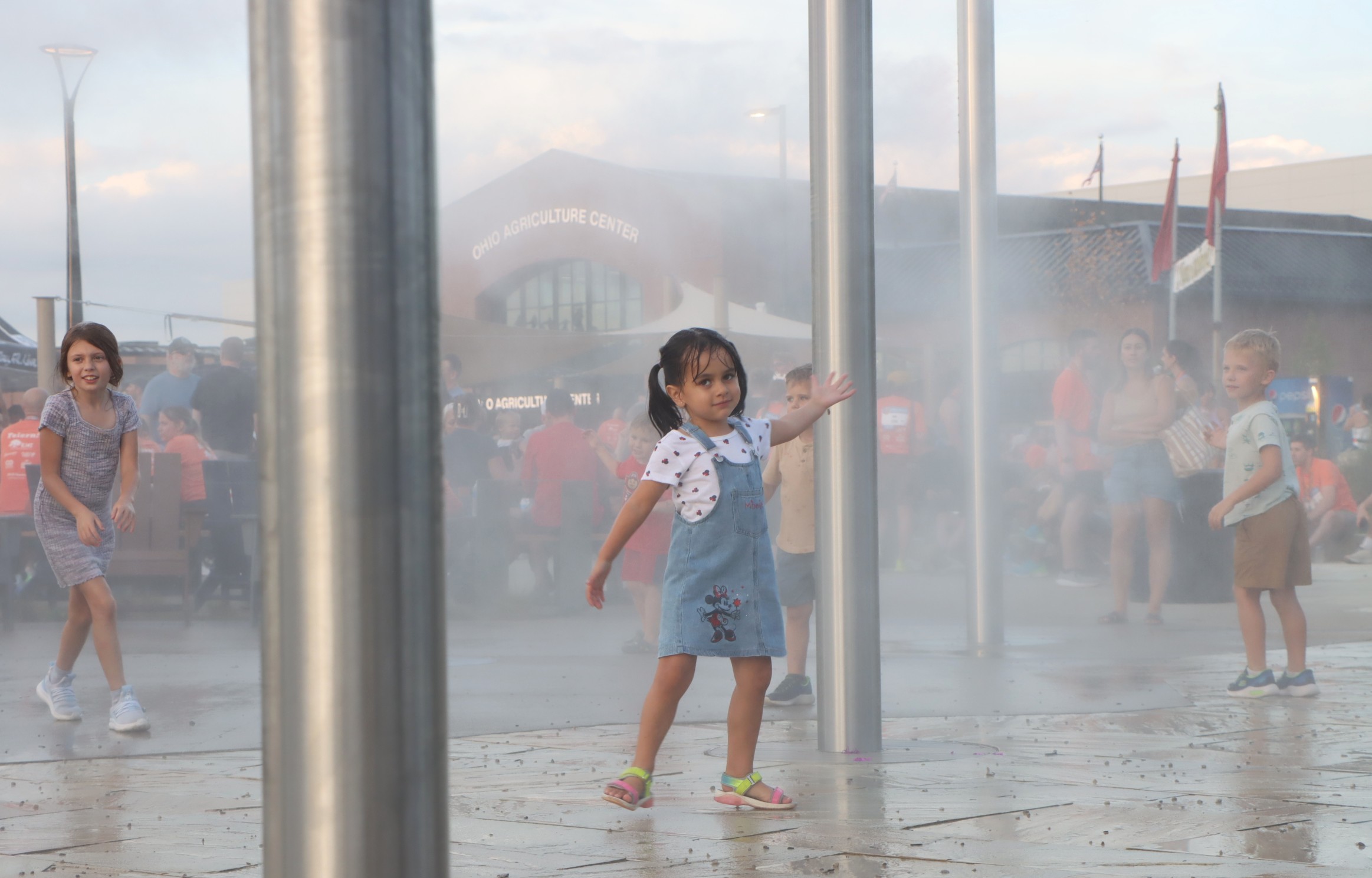
Each pole runs Kool Fog nozzles, which atomize water at pressures approaching 1,000 psi into the fine mist visitors walk through. These are paired with RGBACL LED linear lighting sized to fit inside the pole’s diameter, two-foot fixtures in the 10-foot poles and four-foot fixtures in the 12-foot poles. Each pole’s nozzles are also angled to spray in different directions. So moving through the installation means walking through mist rather than around it. It’s a deliberate choice that roughly doubles the usable cooling footprint compared with a one-directional spray pattern for the same number of poles.

ONE PIECE OF A MUCH BIGGER VISION
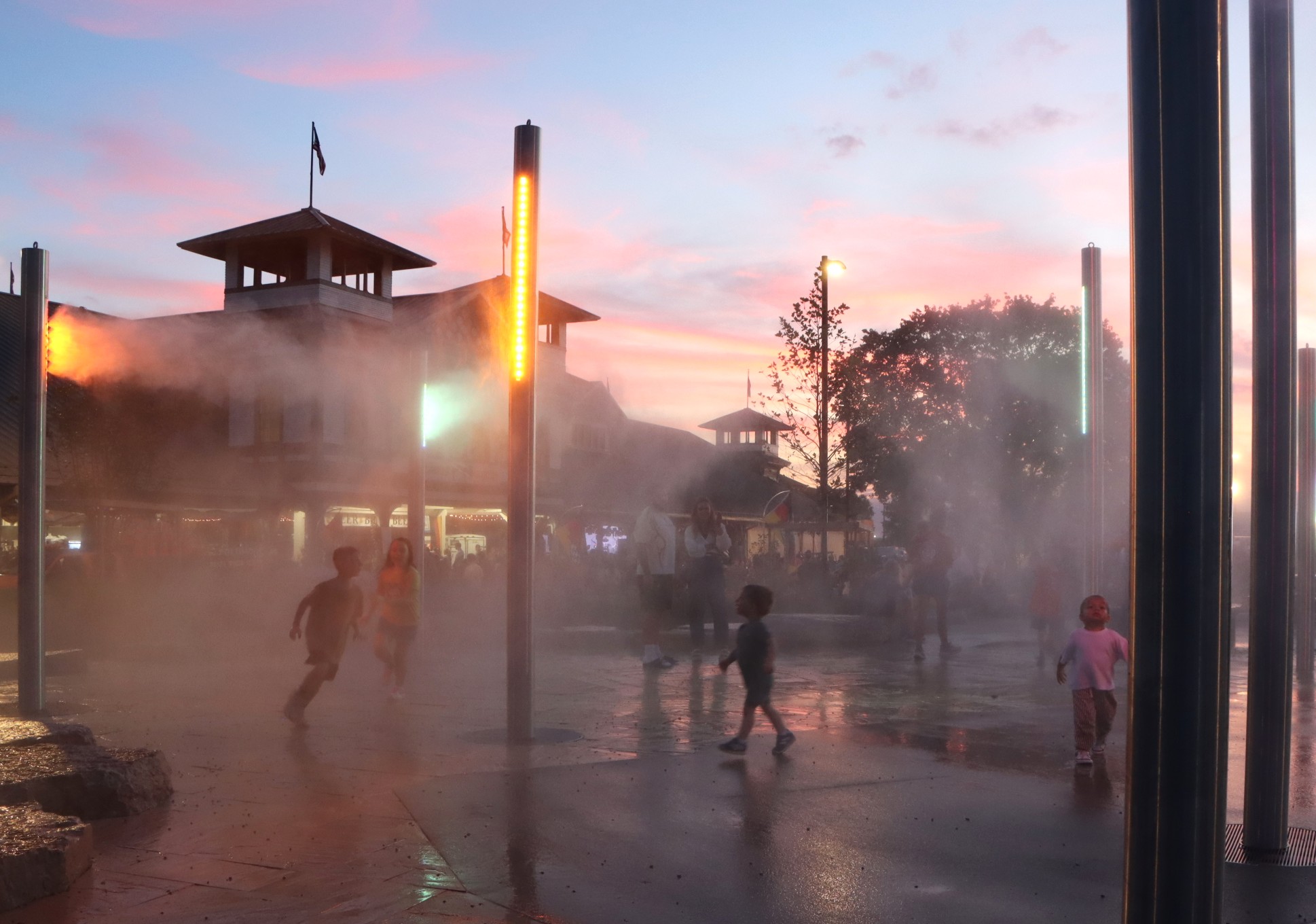
The Glacial Drift misting feature is a small piece of a renovation aimed at solving a much bigger, long-standing complaint about the fairgrounds. For years, most of the site was asphalt and scattered buildings with very little shade. Anyone attending the fair understood they’d be standing in direct sun for most of the day. Part of the broader project’s goal was to greatly improve the site’s overall aesthetic, while providing more human-scaled places to sit and cool down. The Town Square, positioned where the renovation’s main walking routes converge, does both. An amphitheatre and a playground sit just to the west. The misting installation has become an informal extension of that space, with parents resting nearby while kids run through the mist and groups pausing to sit for a while before moving on. As dusk approaches, the linear lighting built into the poles gives the space a second identity after dark.
BUILT TO BE SERVICED, NOT JUST INSTALLED
Fitting a permanent installation into an existing, tightly scheduled fairgrounds site shaped the mechanical approach as much as the budget did. Earlier iterations of the design called for a subterranean equipment vault, which ran $50,000 to $60,000 on excavation and access alone. Rather than that, the final system uses an above-grade, modular fibreglass equipment house holding the fog pump, filtration, and controls.
The feature draws from a fresh, potable water supply, passed through a water softener, cartridge filters, and UV before reaching the poles. It drains to sanitary rather than recirculating, a requirement of running a misting system at all. Crystal Fountains engineered and tested the full package, fabrication, lighting, and fog components together, in-house before it shipped to site. That’s rather than supplying parts for someone else to integrate and troubleshoot in the field. The installation is winterized during the off-season and comes back online with the fair.

FAQs
HOW DOES A FOG OR MISTING FEATURE COOL AN OUTDOOR SPACE?
Fog and mist cool by evaporation. Very fine water droplets absorb heat from the surrounding air as they evaporate, which lowers the air temperature around the feature without large volumes of water. The effect depends on conditions, and it is strongest in hot, dry weather. In one commonly cited example, a fog system can lower the air temperature by about 20°F (11°C) when it is 96°F (35°C) with 20% humidity. Wind, temperature, humidity and nearby structures all change how the fog behaves. At the Ohio Expo Center & State Fair, the misting poles were part of a broader effort to give a site that was once mostly asphalt, with very little shade, more places to cool down.
WHAT IS THE DIFFERENCE BETWEEN FOG AND MIST IN A WATER FEATURE?
The difference is droplet size. Fog droplets are generally under 50 microns, and most fog nozzles produce droplets averaging 10 to 20 microns. Mist droplets are generally 50 to 100 microns, so they are heavier and wet the surrounding area more, while fog creates a larger, more voluminous visual. Both are made by forcing water through nozzles at high pressure. At the Ohio Expo Center & State Fair, Kool Fog nozzles atomize water at pressures approaching 1,000 psi into the fine mist visitors walk through.
HOW DOES AN OPEN LOOP MISTING SYSTEM WORK?
An open loop misting system takes fresh potable water from the supply, treats it as needed and sends it to the nozzles, then drains it rather than holding it in a basin or reservoir. Because fog and misting systems can connect directly to a potable water source, they can avoid a reservoir and large dry pumps, and their supply lines are much smaller than those for conventional jets. At the Ohio Expo Center & State Fair, water passes through a water softener, cartridge filters and UV before reaching the poles, then drains to sanitary. That open loop design cuts the operational and maintenance hours needed to keep the feature running.
WHAT COLOURS CAN RGBACL LED LIGHTING PRODUCE IN A FOG OR MISTING FEATURE?
RGBACL LED lighting can produce pastels, bright neons, greens, purples and oranges, and it can match a specific brand colour such as a Pantone hue. Crystal Fountains cites more than 275 trillion colour combinations, compared with 16.7 million for standard RGB systems. The same fixture can also produce a full range of warm to cool whites to suit the surrounding landscape or architecture, with six channels for colour mixing and one dedicated channel for intensity. At the Ohio Expo Center & State Fair, RGBACL linear lighting is sized to fit inside each misting pole, with two-foot fixtures in the 10-foot poles and four-foot fixtures in the 12-foot poles.
WHAT SHOULD BE CONSIDERED WHEN PLANNING A FOG OR MISTING FEATURE FOR A PUBLIC SPACE?
Start with the site and the climate. Fog and misting features suit outdoor public spaces in warm climates, and wind, temperature and humidity change how the fog looks and how far it carries. Fog also reduces visibility, which can matter in high-traffic areas, and security cameras may not capture people walking through it. In climates with freezing winters, the system needs winterization to protect equipment from freezing. At the Ohio Expo Center & State Fair, the poles carry the nozzles and lighting high because no walls or barriers bound the space, and the installation is winterized during the off-season and comes back online with the fair.